Gaming Nomenclature

Few people know this about game design, but there is not a shared language of terminology to describe like results. A game mechanics like hit points might be called a personal resource or a game battery or a wound meter or any number of terms based on which designer you are talking to. And most avoid using terminology altogether when talking with consumers because how exciting is it to talk about attribute nodes colliding with your thematic/categorical action-response arcs in a four-player worker-placement euro-hybrid defense game.

I could go on about the lack of consistent nomenclature in gaming, but I want to talk about it from a different perspective that just consistent terms from designer to designer. What I’d like to address is the lack of subject agreement logic, concise language, and specificity that makes gaming a chore.

Let’s start first with something that drives me kind of nuts going on in the hipster movement: retro-thematic terminology. I don’t care how good your game is, if you feel the need to call a mechanic that objectifies an action “reify”, you are trying too hard. If your game mechanics require that I use a very specific parlance “I do not agree with your supposition, old friend” in order to activate the oppositional matrix, you are trying too hard. Even Unknown Armies “can of whoop ass game mechanic title” rubs me the wrong way and I love most everything Stolze writes.

But enough about my personal dislikes, let’s get to subject-agreement in writing.

Half of what I’ve learned about technical writing comes from having to edit two-cents per word freelance submissions. Back in my Shadis days we had a number of great writers turning in work for almost nothing, but there were also some never-been-published rookies who loved cliche, poor clause structure, and a lack of understanding of subject agreement.

Every board game, card game, and roleplaying game fails to understand the value of subject agreement. It’s kind of like a rule that floats around in the background and when it’s followed it just tightens everything up nicely. And when it’s ignored, well…. only grammar “ethusiasts” really notice it. But it kind of works like this.

Your card titles or your section breaks are either Nouns, Adjectives, or Verbs. They are not all three. You shouldn’t have a book chapter called Equipment, followed up Quick or Running. It just doesn’t make any sense. The same goes for subsections of your books or cards. Or whatever. Now, CCGs are huge detractors from these rules and they shouldn’t be. They probably have the most to gain by using a consistent structure. Structure, not stricture.

Imagine Magic the Gathering always using adjectives for enchantment spells and nouns for sorcery spells. Creatures are already proper nouns and artifacts usually are too. But what if interrupts had to be verbs? All of a sudden the game might click even faster for people attuned to these kinds of signifiers.

This kind of adherence to nomenclature may seem overly anal, but imagine it this way. There’s an intuitive signifier at play here. If I am reading a book and nouns are always used to signify locations, verbs signify action cards, and adjectives signify enchantments/enhancements, that’s one more signifier I can intuitively draw from to know what kind of card is in my hand. But if an action card title is constantly different, then I’ve lost access to this signifier. And modern gaming is about signifiers, usually graphically, but as games grow more complicated and simplified at the same time, these signifiers grow more important to publishers.

Ticket to Ride may be one of the best examples of graphical signifiers in the board gaming world. Colored cards have different shapes, textures, and trains on them, all signifying that a card is yellow or red or whatever. So, even if you are color-blind, you know one card from another. A circle from a diamond and so on. These signifiers exist in graphics whether you are paying attention or not.

But they don’t exist all the time in writing. And writers who take the time to go back and check their chapter headers and section headers and mechanical nomenclature may seem an improvement in their documentation once they realize that subject-agreement is a powerful and useful tool for any kind of technical writing.

And yes. Most gaming material is technical writing.

King for a Day Update

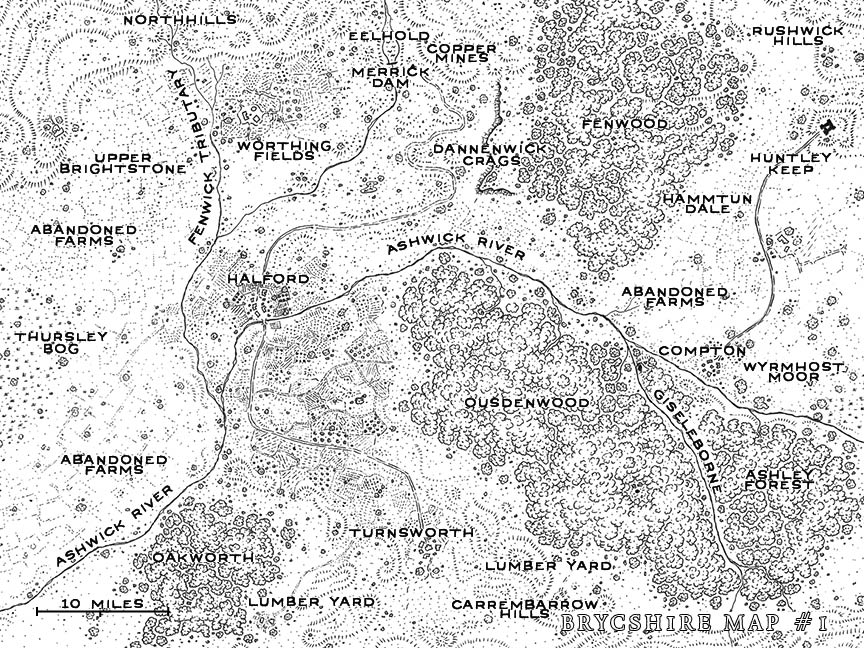
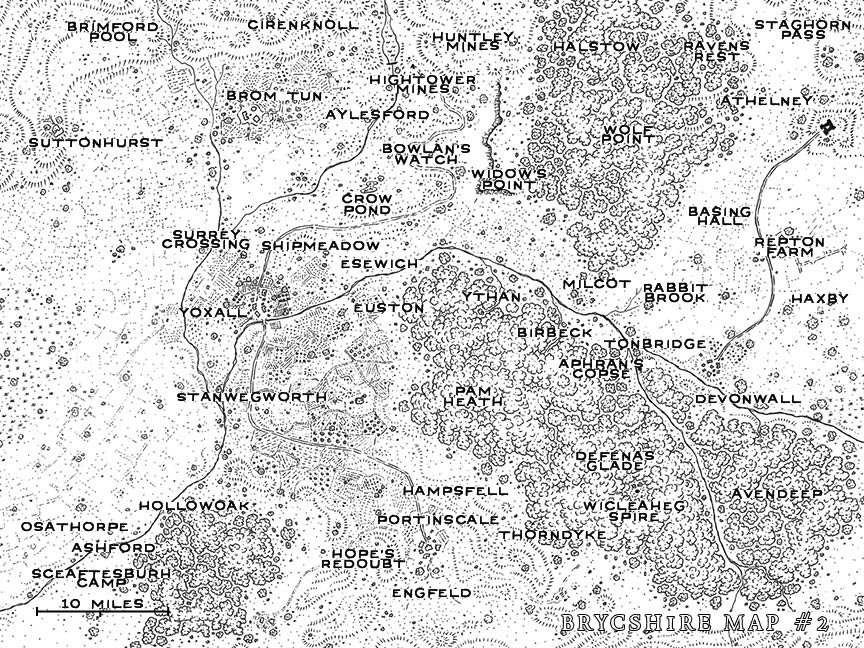
Over 250 pages of the book are completed and Jon Hunt is working on the last two pieces of art. All of the maps are done, although I may ask Alyssa for one more.

What is completed going to be edited by some of the backers as we speak. Which is awesome.

In the mean time, I am going to Vietnam for three weeks. So I won’t be completing the project until shortly after Thanksgiving.

I appreciate everyone’s patience.

Here’s a piece of art to tempt you with.

King for a Day Update

I am plugging along on the writing. Lesson Learned. Have more writing done before starting KS project.

I am gone the entire month of November, so the plan is to get as much writing done as possible by Oct 30 and get the PDF into editing.

Anyway. Just wanted to keep everyone informed. Thanks for your patience.

Post 100 : Designer’s Notes

I am not a fan of designer’s notes. I think they are self-indulgent and usually bore the reader. If the work cannot stand on its own, chances are the designer’s intent isn’t getting across in the game play. No ounce of “notes” is going to fix poor design choices.

That said, I write them a lot. And I don’t like this aspect of myself. I wish I didn’t write them, but I do. I mock others who do it and find myself chattering away about my own nonsense because I think someone cares what I think.

Which, ultimately, they do not. If they are anything like me, they just want a fun game. Who cares where you were standing when you came up with Omelet Race 3000.

Mostly, I am not as good of a designer as I would like to be. I know how to break down a design, find flaws in it, break it into individual pieces, examine them, look for alternatives, and put it back together. And I can do this with most anything. So long as it’s someone else’s designs. But I approach so much of my own work intuitively, rather than structurally, that I can’t always shatter my own designs. Which is a horrible skill set to have. You know? If you want to be successful.

Of course, a lot of the times what I make doesn’t work the way I want it to. And I have to abandon an idea, or accept that it won’t be as good as I want it to be.

Again. Because I’m not as good as I wish I was.

The hope, sometimes, is that this self-awareness and this ever-present need to write designer notes will somehow intersect at a place where what I know should be in the game and what I put into the game match.

Why all this introspection, tonight?

Monica Bellucci said of working on Irreversible:

To me this film is like Clockwork Orange. It’s like Pi. It’s like Requiem for a Dream, Deliverance or Pasolini’s movies. All those movies that are so difficult to digest but there is something, there is meaning. You felt so disturbed when you watched those movies because those movies go deep inside you and then you have to see the monsters we have inside.

That’s a ballsy thing to say about any art form.

But it struck a chord with me. Or at least got me thinking.

How far can a writer/director/producer/artist go to find truth? Is a good game designer on the same path? Can art inform our design decisions? Can the divining rod of a design document mirror another art form so that instead of making a game about cowboys killing zombies, we can make a game about cowboys as a metaphor for a helpless era of human independence killing zombies that represent the mediocrity of an impeding age of industry and soullessness? Does that game all of a sudden become more brazen? Or just more obnoxious? Does it find new ground to stand on? Or does it ostracize the people who came before?

I don’t have any answers. But I’d like to think that I can continue to ask these kinds of questions and get somewhere deeper.

Fiasco : Playset : Dark Dark Fantasy

The Wizard and the Map are Dead

Mordor won. The sun has turned black. Ash and cinder coat the landscape. Famine. Plague. The list goes on.

Whatever life is left… it isn’t good.

Gold hoards are rumored everywhere. Everyone knows someone who knows someone who has a map. Or a trinket. Or some forgotten bit of history. But what does any of that matter when there’s nothing of value anymore and life is cheap. Subsistence and meager survival matter for most.

But for a small few, life is a little different.

Adventurers stand out from the norm. While most dig in the mud, eking out what little food they can to survive, opportunists — thugish, cruel opportunists — pass through the landscape stealing what they can and slaying to keep it.

If life is going to be short, ugly, messy, and sweaty, then they are going to get theirs as quickly as possible.

This is a dark fantasy fiasco.

Dark Dark Fantasy

Strength of Character — Axioms of Morality

Thanks to scores of bad video games in the 80s and 90s, digital roleplaying games are nothing more than “adventure games” where people put on funny pants and change their hairdos as story “benchmarks.” Characters are always on some revenge trip and eager to save the world from some tired cliche of villainy. And from all that bad stereotyping comes a slew of confused morality tales; games where you have no choice but to do what the author considers to be the right thing. “Ah. Slay the lich you say. Of course. He’s not a confused man, but a vile evil that must be stamped out. I won’t bother learning anything other than how to slay him.” It’s the plot of transformers all over again. Omegatron is evil because OpPr tells us so!

And when games like Fable and Mass Effect come along, trying to create “choices,” but all they really do is confuse us even further. Though we are sold games about tough choices, we’re really just sold a game that keeps a running total of how “nice” you were during your lack of choices. These games aren’t about choosing between good and evil, but rather about choosing between nice and mean — even the Genophage decision you make in Mass Effect 1 (which could be considered an evil act if you destroy the cure) gets white-washed by the final episode.

I mean what the heck?

This one-dimensional methodology of storytelling doesn’t stop with video games. Genre TV, anime, 4-color comics, Bruckheimer movies. The list of lazy approaches to morality in writing is long enough that I think I’ve made my point and I can start a new paragraph.

Players read crap, watch crap, and digest crap and then come to the game table with a diet of crap as their foundation for storytelling. Is it any wonder old school gamers and new age gamers clash? [Then something amazing like Breaking Bad shows up on TV and no one knows how to translate it into gaming. I think I’ll do another post about this subject another time.]

So while players show up with their highly sanitized view of Midwestern ethics and assume the rest of the world thinks the same way they do, roleplaying games stymie and grind to a halt, lacking any innovation in terms of tone and theme. “Oh look. Another war of ancient forces trying to shape mankind. Ho-hum.” With the players having all this bad fiction to reinforce their play style, it’s not confusing how quickly they resist anything that’s not sanitized “just right.”

Add to the mix, a plethora of bad adventures written to “trick the players.” Every bad game writers thinks, “this will really get them.” [Meet one of these guys at a game convention and try enjoying his session. Ooofff.] What’s more, clichéd writing and overused tropes have ruined players trust for NPCs and so even the nice ones aren’t to be trusted. Everything is upside down and the entire genre of writing has cannibalized itself. The readers can’t agree on what constitutes good writing and the writers are getting paid 2 cents a word to churn out all ideas.

All of this combines to create a foundation of poor association between right-wrong, good-bad, evil-notevil, stinky-clean.

Which brings me, along a very strange path, to my ultimate point.

Nice does not equal good. Mean does not equal evil.

To often in gaming, as soon as someone behaves like a jerk, we associate him/her with evil. As soon as they say one bad thing about a PC, they are the enemy.

But the world doesn’t work like that. What was “ethical” or moral 5,000 years ago isn’t necessarily moral now. And certainly not across cultural boundaries. Spartans used to through babies with malformed skulls into pits so they would starve to death. Not “nice,” to be sure. But evil? When it develops as a tool to keep their society strong?

Elements of story that were once tools of questionable ethics have been discarded. Tough decisions are gone. And players who think an NPC is mean, quickly work to get rid of him/her from the story. RPGs have become places for staying forever inside our comfort zone.

And what about Paladins? All Paladins are douche bag idealists who impose their will on others. But, does that make them evil?

Add to all of this confusion the fact that we are now desensitized to true acts of evil. Video games create monolithic robots of rage and fury that are unleashed on the earth to destroy everything. So in order for something to be truly evil in a game context it must eat babies and destroy entire nations. The messages of what is “bad” are so confused, we are always stuck looking into the barrel of the ethics gun and wondering if there is “nice” or “mean” in this chamber?

Could all of this be related to the “self-esteem” generation that gets trophies for just showing up?

Any sociologists out there who understand young people want a crack at that one?

Games like Skyrim are trying to break out of this mold (so I’ve read). The upcoming DayZ has a new approach to decision-making trees. And Heavy Rain and Walking Dead are new interactive-movie style games that give players more control over their decision matrices. Perhaps in an attempt to break away from the narrow-minded one-dimensional storytelling approach that results in mean-nice axiom that people have been confusing with evil-good for so long.

Maybe that’s the new road? I hope so.

But in its stead, we have players and GMs (in a tabletop context), devoid of decision trees, still adhering to antiquated models of good and evil. As soon as a bad word is said from some idealistic do-gooder, he’s no longer someone to be trusted. Hurting feelings somehow violates any possibility of righteousness.

It’s a perplexing paradox is you ask me. One I don’t have an answer to, but I’d be curious to hear from others about this.


Turn Undead

Once again, there is chatter about how Turn Undead should work. The latest edition of your favorite fantasy gaming is vexed over what to do.

Zombies turning and fleeing? Seems impossible actually. Skeletons so scared that they turn around and face the wall? That’s fun and heroic. Mummies flailing their arms like they are doing the “monster mash”? That’s exactly the kind of fantasy I wanted to be playing.

[Assuming pandering tone.]

So. Why doesn’t turn undead just do damage and increase you AC in regards to undead?

Why is this so complicated?

I think I’ve written this in 3 different d20 books.

The truncated version is this:

Your Cleric Level in d6 dice against undead X times per day in a 15 foot radius. Paladins roll d4s. You can choose a Feat to increase the damage and another to increase the range. This ramps up fast, so you may need to temper the values to match the edition you are playing.

You Level is also added to your AC (for the purposes of undead) for 3 rounds. You can select a feat to increase the duration.

Can someone get a towel for my brow. I’m sweating here?

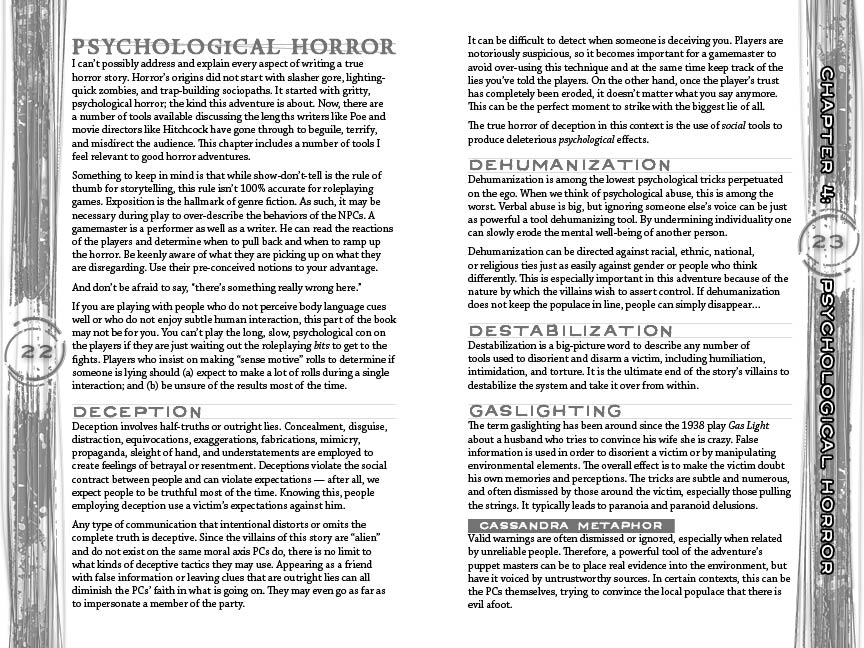
King for a Day : Interior Spread Sample

I am a long way from the finish line, but this spread is done. Thought I’d give you a taste of the “advice” portion of the adventure.

Note: I used Ringbearer as the header typeface, which is going against my own rules, but it really is that damn strong. The body is Chaparral Pro, which has so many extra glyphs, I just couldn’t go wrong with it. It’s very strong, as well.

Blah. Blah.