George’s Children

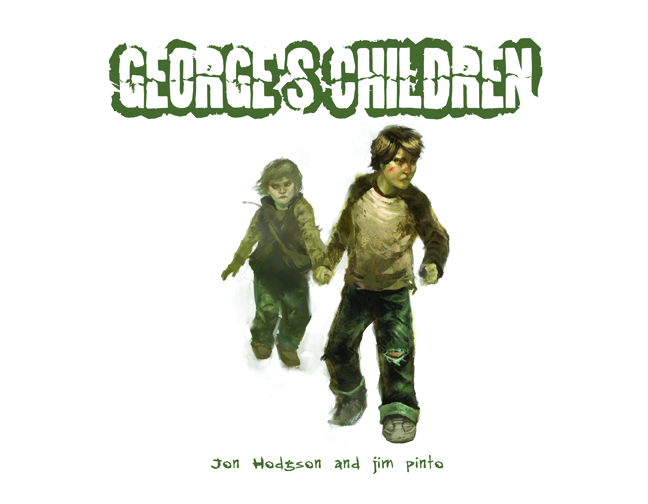
A few years ago, Jon Hodgson and I created a game called George’s Children, a game about children in a post-apocalyptic world dealing with the loss of anyone over the age of 13. The themes tackled in the game were heavy, even if the execution wasn’t pitch perfect. And because the topic, content, and source material were all very important to us, Jon and I decided to donate the profits from the sales to charity.

The game wasn’t for everyone and our lack of marketing dollars made it difficult for the game to find an audience.

This game is still available, but expensive, because it’s a POD through Lulu.

I am presently planning a re-boot of the game and hope to eliminate Lulu from the process. I don’t know how soon this will be, but the new game would be a different size and include additional set-up rules, as well as advanced play.

In the mean-time, if you’d like to contribute by buying a copy now, you are welcome. We are really proud of what we made and this game has been enjoyed many many many times by myself and others because of it’s evident style and tone matched the game’s precepts.

Artist Spotlight : Anna Christianson

I’ve been art directing for over 10 years. I’ve seen thousands of portfolios. Most are a blur. You see the same bad stuff over and over. Can’t draw hands. Can’t do 3/4 poses. Can’t blend. Can’t transition. Can’t pop. The list goes on. Even the amazing portfolios are clones of Brom and rk post. So, when I met Anna a few years ago at Gencon, her portfolio was alive and original, I promised her work right there on the spot.

Seriously. Two card images.

I sent her over to talk to Zoe at FFG (and a few other people) that day as well. And I hope it helped, because I she’s working on some cool properties.

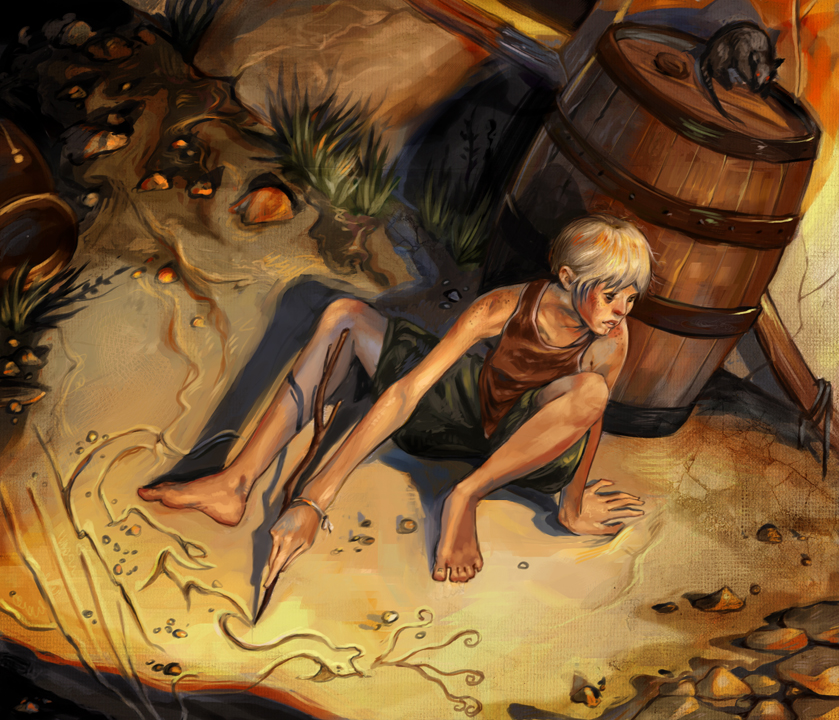
Below is a piece from the Game of Thrones CCG. I love the story going on here. Anna did a great job bringing it to life and her A.D. concepted an evocative scene. I’ve written over 10,000 art descriptions in my career and never this one.

Seems like a great low-level power or 1st-level magic spell. I would expand on the idea here and make it instant Recall of “one thing” you’ve witnessed. You can even cast it on someone else, so they can describe someone or something with absolutely perfection. Great for a fantasy campaign filled with investigative elements. Material Component: Stick.

Anna started drawing as soon as she could hold a crayon. She grew up surrounded by art (both parents are artists), but what really cemented her love her introduction to a steady stream of great fantasy illustration — books like “Faeries” by Brian Froud and Alan Lee, Magic Cards, and the cover illustrations to her favorite fantasy and science fiction books. It was abundantly clear that illustration was the only real option for Anna’s “career.”

Anna graduated from the State University of New York at Fredonia with a BFA. Since then her illustration work in the gaming industry has flourished, with a focus primarily on fantasy and science fiction. Anna works mostly digitally now, but painted traditionally for many years. She is most often inspired by biology, anthropology, history, and philosophy, but more importantly by the amazing work of her fellow artists.

She currently lives in Rochester, New York, with her cat, Orc… and her boyfriend, Reed… in that order.

I hope she’s the first to admit her site needs a little more love. Only 15 images. What a tease! What she has there is strong and I love her environmental pieces the most. Take a look at her work at http://annaeatspaint.com/index.html

Perception Rolls Re-Revisted

In the past, I’ve made comments about how certain RPGs have too much variegation as to how Perception is handled — do I hear it? see it? notice it? smell it? And what is it? My previous arguments have been about how to deal with too many stats governing perception — cut them all down into one Skill roll. [The same goes for hiding stuff.]

But I’m taking a new approach today.

You’re a gamemaster. You’ve written a adventure/story/headache that you want the players to enjoy/endure/report as torture. You’ve already taken advantage of their Bardic Lore (more on this later) and fed/informed/scared them with the “mission”  information. You want them to get to the castle/tomb/underground lair of ugly brown things and encounter/slay/taunt the plot.

So, why are you asking them to notice your adventure?

Perception rolls require that I notice something. But what if we all fail to notice what you want me to notice? What was the point of the roll? Did we not find the hidden sigils on the tomb door showing the entrance? Did we miss the turn at Old Mill Road? Are we about to get ambushed by traveling minstrels? What do you mean we’re hunting rust monsters?

There has to be a reason for a gamemaster to call for a perception roll. One can’t just ask for them arbitrarily lest Perception become the dominate stat behind “kill things you notice.” (Not to mention that the more you call for rolls, the greater the chance of a critical failure or success. And nothing is more exciting than a critical success on noticing a fossil.) If noticing things is paramount to the game and the task of noticing it is left to the dice, why did you write it in the first place? Don’t you want the players to play your game? Maybe immerse them into the things they are seeing/hearing/tasting.

Now. I can see the value of a Perception roll in relation to the {VALUE} of the thing.

You find the entrance the tomb. Sigils cover the door. The command word scrawled in some ancient tongue. It could be Elvish or perhaps something diabolical. However, some of the letters are missing and the rough worn stone shows signs that someone has defaced this rock.

A Perception roll here can do a number of things. It can help reveal the language (unless the game your running has decryption as a skill; although even then a good Perception roll by give some bonus to the decryption). It can help to find the indentations of the worn stone so the edges of the sigils can be fully drawn out. It might even help reveal how old the work is, or what kind of stone was used to deface the sigil. It might do a hundred little things that all up to a bonus to get through the door. But the Perception roll should never replace the story points that have to be “found.” The players have to find the door and the sigil to get into the door. They don’t need to know that trolls did this. They don’t need to know that the sigil was written in a banished form of Elvish that brings harm to the reader. And they don’t need to know that the sigil, when read incorrectly causes the door to seal permanently. These are all valid elements to define failure.

Not finding the door means the adventure fails to happen.

Surprise
The value of Perception rolls in combat are invaluable. Gamemasters can keep information about the enemy hidden from players who can’t see the enemy archers or who fail to notice the traps and so on. And being ambushed in combat is a trope of the fantasy-adventure genre. I would never even consider removing these from play. Having a scout in the group to notice the ambush is invaluable to certain styles of play.

This extends to “searches for traps.” PCs should never have to actively search for traps. A game will grind to a halt as the player takes a five-foot step and searches for traps and repeats ad nauseum. Rather, the gamemaster should consider a passive system (see below for an example) where the rolls are only called for in situations where the potential to find them might actually exist.

Ratchet up the Tension
Before the game starts, consider secretly rolling five Perception rolls for each player at the table. Keep the information secret. It’s okay if the players know you are doing this, but not what the results are. At random times during the game (or at moment’s key to a specific character’s fate), pick a random Perception roll and use it to determine the necessary {VALUE}. You’d be surprised at how quickly this becomes routine for your games and how the player’s stop arguing about “can I roll to notice that?” Their eyes and ears are already dependent on the gamemaster for interpretation in so many other formats, why not here as well.

Bardic Lore
I feel like I covered this extensively in the d20 Topic series I wrote years ago, but in case I didn’t…

There are a number of character abilities in game that do nothing more than “advance the plot.” 99% of Information/Knowledge-related skills do nothing more than give PCs information they must have to advance. For instance, a Microbiology roll might indicate that the science lab under investigation has been performing Eugenics experiments. This is hardly beneficial information to the players. It’s vital to the story, but the PCs want some {VALUE} for their skill points, and skill points that just advance the plot are a waste of everyone’s time.

Information skill checks, before/during/after the adventure must impact {VALUE} to the player, regardless of system. Even in a story game, some sort of {VALUE} is passed at the end of a scene. What this means to the gamemaster is informing some system of {VALUE} associated with these skill checks, e.g. an information check about the enemy you are about to hunt down might reveal that the skull orcs behind the kidnapping are particular sensitive of very bright light. The PCs will be keen to exploit this information, so whatever penalties the skull orcs would have received from bright light is now doubled as a result of this skill roll (assuming the PC imparts this information to the rest of the team).

To use the above example of the Microbiology roll, the PC (as a result of even having such a pedantic skill) knows about the experiment. However, a good roll here informs the PCs that data from the eugenics experiments has been compromised on two different occasions and a Mr. Pembrant has been called in both times to sign off on the project resets. Using the name Pembrant later in the adventure will impart a +2 to any Social skill rolls to get information out of any scientists encountered.

Some of this abstraction seems foreign, especially in games focused on simulationism. But I point the finger of some of this behavior squarely back on the old school style of ME vs. THEM (GM vs. PC) inherent in so many designs. I know a lot of modern players don’t have this issue anymore, but it doesn’t stop some games from drawing upon archaic paradigms.

Fiasco : Playset : High School Hijinx

My second attempt at a Fiasco playset. Please see The Dirt People for more Fiasco goodness. [Sadly missing from the movie list is Heathers.]

I’m So Bored I Could Kill Myself

So. Like. There I was, you know. Sitting in class and I’m like. Yeah. So. This is really boring. You know. And then Angie. You know her, right? Well. Like. Angie, she is hands me this note. And I’m like OMG. I know. This is so boring. Thank you. And then I’m like, let’s go to the mall for lunch. You know? Okay. Yeah. We can see what Darren and Casey are doing, too. And maybe, I don’t know, we’ll all find a way to just never come back here.

God. I hate it.

Or something.

jp02 High School Hijinx

Famine I

My ongoing game design will be called Famine. This is the first of many posts.

I don’t design every project the same way. I’m not built that way. Some designers are craftsmen and tackle everything with the same verve and personality. I wish I could do that, but… well, now I’m just repeating myself.

In this instance, I am starting with an idea that arose from watching the movies Chronos and Let the Right One In (ostensibly the same film). In this game, the players are drawn by some kind of Hunger (ironically, I’ve not seen the film, The Hunger — but don’t worry, I will before this is over).

So. I’m going to start with my design objective. What I know so far is that I want the players to be “undead” in a constant state of hunger. But not the new-age vampires that have become so popular (twice now) in the last 20 years. At this stage, they are just some kind of generic undead (ghouls, revenants, whatever) that must feed to stay alive. I know I need a conflict, so that means two stats (at least) in opposition to one another and perhaps a player at the table who will always play your foil (conscience, forces of nature, and so on).

Hunger of course will be one stat and Willpower another. Because the players are undead, they’ll need some sort of Power Score as well to indicate how easy or hard it is to do something. I don’t want to rely on this kind of design crutch too early, so I may hold off on that. By virtue of being undead, maybe they can do things that are really cool already. We’ll see.

With this kind of game, mood is everything and in order to really capture the ever-present fear of starving, I’m want the players only rolling dice in the most dire of situations. When the dice come out, that means things are bad, or about to get much worse.

Success and failure should be WIDE extremes.

Invariably, the players are going to grow more and more hungry as the game goes, so failing should happen more often than success. Which means a game with a d6 (for instance) would probably have a 5-6 as a success on a single die. Already I’m seeing the value of a die system like the one from Jovian Chronicles, so I’m considering borrowing what I need from that.

We also need something for the players to do. What is the crisis? What is the thing in front of them? If I were designing a traditional RPG with a GM, this answer is very easy. The players are hungry and it’s the GM’s job to keep them hungry. Possible, but it’s lazy design. And I don’t intend to go that route just yet, especially with such a cool nemesis angle above.

Hungry creatures might have favorite places to hunt, food stores, and a warren to hide when things get dangerous. Without copying too much from the WoD, I think those three things could also make interesting stats on a character sheet. Or communal stats that everyone must protect.

I think I have enough ideas to get started. I just need to write up some notes, make a character sheet, give it a quick run through, and then figure out how a scene works.

Part IV of V

I like book compilations and sets. I love trilogies and quintads. If Jeph Loeb ever produces something I like, I’d also love books in a series where each one is a new month, day, week, year, thing. I love it when progressive bands do part IV of a trilogy and complex song structures that take 65 minutes to resolve.

I think if you have the right set of themes, you can even do games in a series. For instance a game all about suffering and giving up something you love for something you need… followed by a game where you start with nothing and have to achieve everything… which anchors to a board game about growth and destabilization… and then dovetails back to a card zen-like card game like Uno, where you have to lose everything you have.

The Gipf series of board games is a great example of this. But designing across mediums  has proven difficult in this hobby. Most gamers who enjoy a thematic board game, might not also play the roleplaying game or historical miniatures game that ties all those elements together. And there is a long track record of failed projects by people trying to design a CCG-RPG or some similar hybrid.

Over the coming months, I intend to design a new RPG (with cards) that crosses over two different themed sets of games that I have in the hopper. To make it even more interesting, I’ll be designing this project step-by-step on this page, walking through each design aspect of the game.

Stay tuned.

Ugly Dog

Above you can find two REAL pictures of dogs that have won “World’s Ugliest Dog” contests. Both have some level of Chinese-crested thing going on, which makes me wonder about Chinese dogs.

The real reason these two are on here, though is two-fold.

1. I just found out about this contest and saw these two pictures.

2. Don’t they look like they’d make great familiars for a lich or necromantic warlock or something? Seriously? Creepy stuff.

Okay. Back to work.

Artist Spotlight : Raven Mimura

I met Raven in 1996, long before either of us were anyone — in fact, his first art gig was with Shadis magazine — and certainly long before he was as good as he is now. Raven’s work spiked around 2000, and before I knew it he was too good to hire (read expensive). He’s been dominating at Wizards and White Wolf for years.

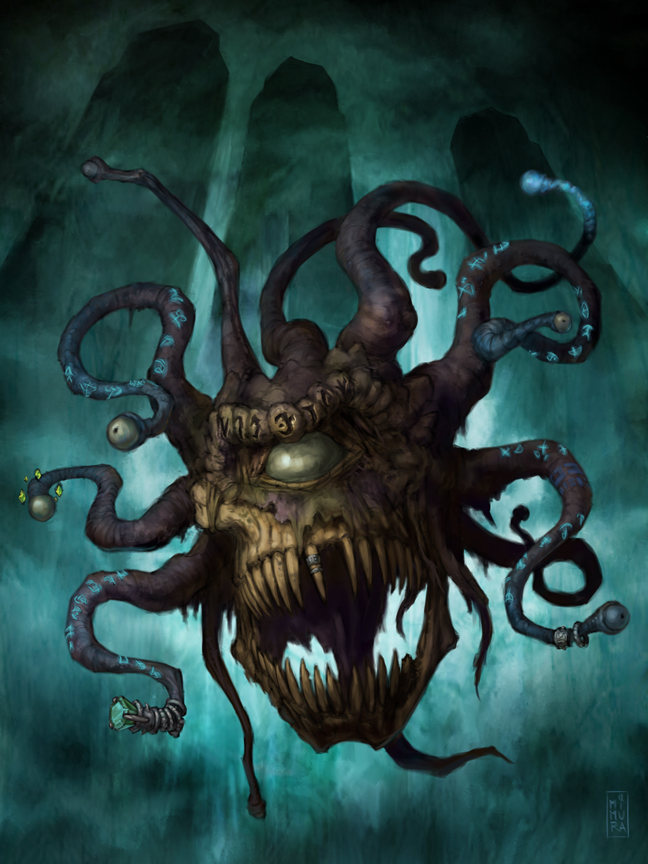
Below is a Lich Beholder thing from some D&D product and a sample of how deadly Raven is with paints.

I love the runes on this, the emerald in the bottom left tentacle, and the battered nature of the piece. Raven is a maestro with the details. Take a look at more of his work at www.ravenmimura.com.

As for this bad boy, if you intend to drop him into your games, I recommend doing something cool with the runes. Make them permanent effects that have been magically seared into the beholder making him even more powerful than he normally is.

Dying Memories

The first of several “small games” on my horizon is Dying Memories, a science ficiotn game that really isn’t science fiction at all. Heavily inspired by Charles Ryan’s Psychosis, Dying Memories takes an antithetical approach to game play.

In Dying Memories, players take on the roles of crewman trapped in cryogenic sleep aboard a space ship in deep space. The ship has gone adrift, heading into the orbit of a wayward planet. As the ship’s unavoidable and tragic decent to the inhospitable world continues, the crewmen suffer traumatic episodes of fragmented memories from their past, in an attempt to rebuild their lives. Their final moments spent trying to formulate who they were and what is happening.

Dying Memories is a structured freeform roleplaying game which strings together relevant scenes from the characters past. As the game progresses, the players’ unconscious unravels more and more perceived truths about their past as they attempt to find the missing memories that made them who they are.

Without a gamemaster and devoid of many rules, the players are free to define their activities however they like. Four to five players are best.

Games to Play

There’s a lot of clamor about what makes a great game. Different tastes promote different kinds of gaming sites, which in turn leads to fracturing of the gaming culture into little islands of game design thought.

I can’t really comment on what other people like and desire or why they’ll play one guy while claiming to love another kind. I think if you don’t work in games all day long, you develop a different language for expressing what you like and why you like it. And frankly, the vocabulary of expressing LIKE is much smaller and harder to define than the vocabulary of DISLIKE. Critics of anything are well aware of this and it’s why it’s so much easier to review a [thing] negatively rather than positively.

For me, I’ve spent a long time being very vocal and opinionated about why I like something or don’t like it. Which is ironic, because when I was at Shadis magazine, I had a strict policy of only talking about what I liked.

And I’m not exactly sure what happened. Granted, I’ve always been very opinionated, but I think working in a creative milieu does things to you. Having a good idea isn’t enough. Especially with design by committee. You have to explain why it’s a good idea and then fight to include this great idea. Then you have to make this good idea into reality, hope it doesn’t get cut, sometimes fight to get it printed properly, and then at the end of the day marketing may not even know it’s part of the gestalt, and not using it in the marketing plan.

These facets of the industry can grind away at you. Looking back, it’s an environment I am not suited for. And it wore me out. (Having said that) This site will not be about the black eyes of the industry, but the things I love. I want to go back to loving gaming again and not just doing something because Company X needs their game-world to have zombies AND pirates because “we heard those are hot now.”

[Corner me at a convention someday about why I don’t like Kitchen Sink game worlds.]

I’d like to get the ball rolling, but writing about some games that I like. Here is a short list of my favorite games. (Look. I’m actually going to express why.)

Twilight: 2000. The original. I know it’s a dated game. I know the first and third editions are for people who like inventory lists and martial tactics, but there’s nostalgia there. Whenever I play, I can see the blasted landscape of Poland, the obvious parallels of the game-world to WWII, but now with dwindling resources. This game stirs something in me and I can’t get enough. Post-Apoc is my favorite genre, but it has to mean something.  Morrow Project was a brilliant idea, with bad mechanics and even worse writing. Gamma World never did it for me. I’d love to sit down and play some of the smarter games out there in this genre. If you’ve never heard of it, check out George’s Children by myself and Jon Hodgson.

Power Grid. The designer of this product said this game was designed to be played “by the seat of your pants.” Which is an amazing design philosophy that has little to do with it’s final execution. While the game is still hugely successful, no one plays it the way Friedemann Friese suggests. The game is a hit with left-brainers who care less about theme and more about the moving parts of a game. Which is converse to my thoughts on themeless games. I usually avoid them, but this one I love. I’ve only won a couple of times, but I still enjoy the process. For me, the game has many perpetual motion features that I love to see in a game. Expect to see a free little addition to Power Grid on here eventually.

Jovian Chronicles. I’m not a sci-fi fan, which I believe is different from science fiction. Can’t watch Star Trek, or Bab 5, or Firefly, or anything on the SyFy channel. But I loved reading the Foundation and Empire saga, Joe Haldeman’s Forever War, and the Rama novels. Someone should do roleplaying games about those worlds (my apologizes if this has been done). Jovian Chronicles is one of the first ever science fiction roleplaying games, I can think of. GURPS Space might count, but it’s so generic, I don’t see how it can do emulate true science fiction without the GM doing all of the heavy lifting. Jovian Chronicles has brilliant dice mechanics. Really smart. I can’t believe they haven’t been stolen. (Maybe I should do that?) And the varied planets ensures that the GM and players tell the kind of science fiction story they want to tell. Did I mention that it’s set in the near-future in our own solar system?

Psychosis: Ship of Fools. The inspiring roleplaying game I can not describe without ruining the surprise of it all. Requires a GM and some tarot cards, but good players can game without all that. Heavily influencing my upcoming game Dying Memories.

Carcassone: Hunters and Gatherers. While the original is a juggernaut of the gaming industry, I think this pre-historic variant is the strongest in the series. It’s faster, easier to score, and the theme fits more with my style of game. Frankly, there’s not enough nomadic hunting-gathering games out there. GMT’s Dominant Species isn’t bad and there was one called Nomad there really should have been a video game. Just too many moving parts, and too many points to calculate. But it did come in the best gaming package ever… a little leather pouch, thematic to gathering cultures. Phil Eklund also did Origins, which I’ve never played. I love Phil’s work, but this one seemed far to simulationist for me and I never got around to it. If you’ve played it, drop me a note and tell me what it’s like.

Kult. Another roleplaying game on the list. I never loved Call of Cthulhu the way other people did, mostly because I never found the right groups to game with and maybe because the game never fully took itself seriously. For a horror game, I really want crawling at your skin kind of madness, not crazy scientists setting fire to libraries. Cthulhu has its place and I’ll always love it, but Kult is cut above. It’s like gaming inside the brain of Clive Barker and the PCs are the villains of a normal story, forced to kill things even more grotesque than they are. I think I was a murderous cultist in my first game of Kult, trying to stop the evil spirit that made Charles Manson so powerful from returning. Thank local GM legend Tom Cummings for that one. In this genre, I also recommend Nephilim.

Shadows over Camelot. This is perhaps the most saccharine game on this list. But I love it for reasons very different from other people. For starters. I cheer for the black deck. I really like this aspect of play. I’ve used it in design a few times and I love it when designers take this approach to conflict. I also like the tension that can exist when the players are short on actions and the clock is ticking. Because of the numerous paths to victory and/or failure, this game is just a cut above all other co-op games. And yes, I’m aware of the syndrome among co-op games, “the smartest guy should go play by himself and tell us how it turned out,” but that’s not completely appropriate in this game, especially with the potential for a traitor and the fun here being about the journey and not the destination. For a fun $20 co-op game, I recommend Isle of Doctor Necreaux by Jon Leistiko (and developed by yours truly). Would have been fun to expand this game or do different environs.

Aria. The greatest roleplaying game you never heard of. One of the true predecessors to the story-games, indie game movement. Most people have never seen it or heard of it, but it’s 1,000 over what any other fantasy world-building game is. Last Unicorn Games really knew what they were doing with product like this. I can’t say enough about it, even though you’ll never find a copy to play with.

Agricola. Okay. Fine. I like this game. I like the cards and the random nature of the game. I like the complicated nature of it all. I like the many paths to victory. I don’t like the progressive race nature of it, since you can play it solitaire and get almost the same game experience from it. But I think it’s a strong game, nonetheless. If it’s ever released, I designed a board game with an interesting set-up (similar to this) and area control that I don’t think rivals Agricola by any means, but it was inspired by initially. Maybe someday I’ll get to talk about it.

Good Guys Finish Last. Before there was an Indie Games Revolution, there was a little company called Better Games. They made a host of macro-action related roleplaying games, most famous of them being Barony (traditional fantasy), Crimson Cutlass (pirates), and Good Guys Finish Last. All of them were fantastic, but GGFL stands atop a skyscraper, chest out, bellowing it’s comic-book call as the pinnacle superhero game. The game called actions “panels” and there were even splash pages in the game as players took on the roles of writers and heroes. I can always tell when a game designer has seen this game and when they haven’t.

Blue Planet. Another roleplaying game most people never played. This is real science fiction again. Theme. Subtext. Jeff Berber and Greg Benage are amazing, amazing writers and designers. I can’t believe the depth of content here. An alien world that is almost all water is found through a wormhole. Humanity moves to colonize the planet, loses contact for half a century or so, and then tries to repopulate, only to find the colonists living in utopian bliss. Corporations and solar hippies collide. Sorry I’m being flip. But, seriously, if the concept intrigues you, check out this link. I love love love this game. If you can find it, get the original soft-cover single book game. If memory serves, this and Jovian Chronicles may have come out at the same time, making me a liar about which is the first true science fiction game.

Memoir ’44. Part war game and part board game. I love the distilled down nature of squad leader present in this product. My wife even plays it and she’s not a gamer. I have over 100 scenarios for this game, but I’ve barely scratched the surface of what it can do. I do not recommend playing against left-brainers. It’s a fast, fun game and their potential to bog it down with analysis can sour you on it.

In a Wicked Age. While I’ll can’t stop talking about (and writing about) Fiasco, my true love in fantasy gaming and IAWA is everything I’ve ever wanted in an RPG but never asked. Character creation is inspired. Absolutely inspired. And the urban nature of the game means no one is wasting their time on worrying which amulet provides a bless bonus to their neck-slot before opening the door to another empty 10 x 10 room. I really need to play this a little more often.